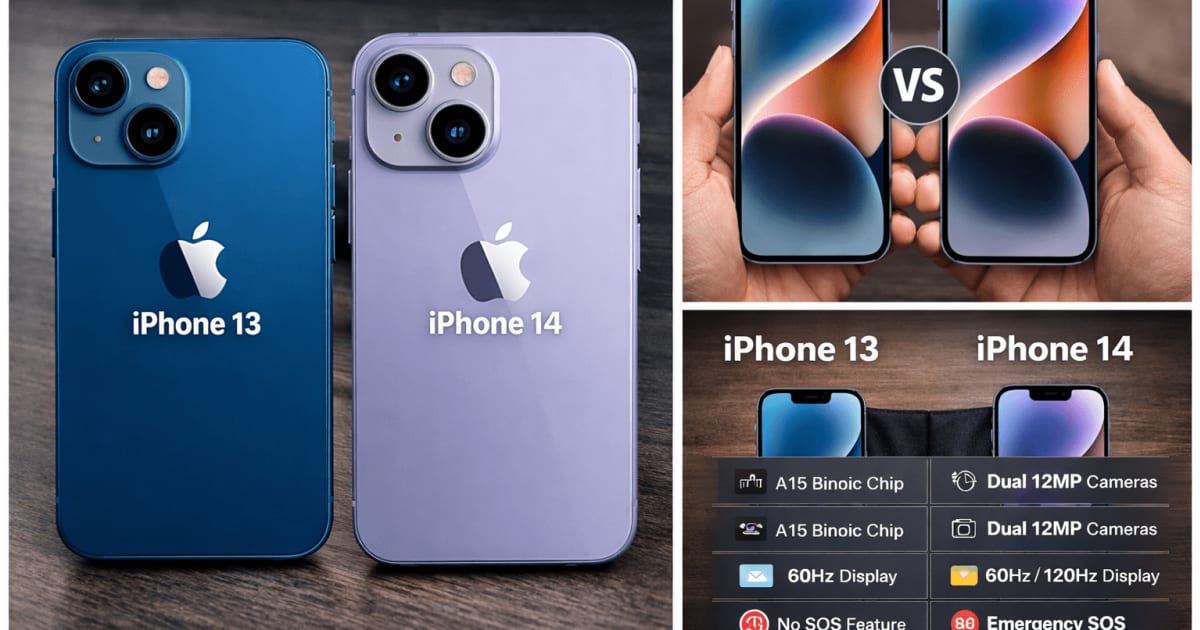
Buy the iPhone 13 if you want the best value. It runs the same A15 Bionic chip, has the same 6.1-inch display, and takes photos most people cannot tell apart from the 14's. Buy the iPhone 14 only if you want its three exclusive features: Emergency SOS via satellite, Crash Detection, and meaningfully better low-light photography. Neither phone supports Apple Intelligence, and both run iOS 26. On the used and refurbished market, the 14 typically costs 10–20% more than the 13 — a premium that is worth paying for safety features and nothing else.
I have spent more time than I care to admit explaining this comparison to friends, family, and readers. It comes up constantly, because the iPhone 13 and iPhone 14 occupy the exact sweet spot people land on when they want a modern iPhone without paying flagship money.
And the honest truth is this: the iPhone 14 is the least ambitious year-over-year upgrade Apple has ever shipped for its base model. Apple did something in 2022 it had never done before — it reused the previous year's chip. That single decision defines this entire comparison, and it is why so many buyers get stuck between these two phones.
So let me settle it properly. Not with a spec sheet dumped on a page, but with the differences that actually change how the phone feels in your hand and your pocket.
The Short Version: What Actually Changed Between the iPhone 13 and iPhone 14?
If you read nothing else, read this table. These are the only differences that matter.
And here is what did not change: the display, the design, the size, the refresh rate, the charging speed, the connector, the water resistance, and the storage tiers. That is a remarkable amount of "same."
Do the iPhone 13 and iPhone 14 Use the Same Processor?
Yes — and this is the single most important fact in this comparison.
Both phones run the A15 Bionic. Not a variant. Not a tweaked version. The same silicon generation. Apple broke its own tradition here, and it has never fully lived it down.
There is one asterisk. The iPhone 14 received the 5-core GPU version of the A15 — the one that had previously been reserved for the iPhone 13 Pro — while the standard iPhone 13 shipped with a 4-core GPU. The iPhone 14 also carries 6GB of RAM against the 13's 4GB.
What does that mean in practice? Almost nothing for most people. Opening apps, scrolling, messaging, browsing, streaming, video calls — identical. You would need a benchmarking app to detect the gap.
Where it shows up, faintly:
Sustained gaming. Graphically demanding titles hold their frame rates a little better on the 14.
App retention. The extra 2GB of RAM means more apps stay alive in the background instead of reloading when you switch back.
Longevity. More RAM tends to age better as apps get heavier over the years.
If you are a heavy mobile gamer or you juggle a dozen apps at once, the 14 has a small edge. Everyone else will never notice.
Is There Any Display Difference Between the iPhone 13 and iPhone 14?
No. None. This one is easy.
Both phones use a 6.1-inch Super Retina XDR OLED panel at 2532 × 1170 resolution, 460 pixels per inch, with the same brightness ceiling and the same Ceramic Shield front cover.
Both are locked to 60Hz. Neither has ProMotion — that stayed a Pro-tier feature in both generations. If you have read anywhere that the iPhone 14 has a smoother 120Hz screen, that information is wrong, and I want to correct it clearly, because it is a claim I see repeated far too often.
Both also have the classic notch. The Dynamic Island arrived with the iPhone 14 Pro, not the standard 14. Same notch, same size, same everything.
Choosing between these phones based on the screen is not possible. There is nothing to choose between.
Camera: This Is Where the iPhone 14 Actually Earns Its Price
Here is where the 14 stops being a rerun and starts being an upgrade.
Both phones carry a dual 12MP rear system — a main wide lens and an ultrawide. Same megapixel count. Same ultrawide sensor. On paper, identical.
But the iPhone 14's main sensor is physically larger, with bigger pixels, and a wider f/1.5 aperture versus the 13's f/1.6. A wider aperture means more light hits the sensor. Bigger pixels mean each one captures more of that light. Together, these are the two things that most improve a camera in bad lighting.
Then Apple layered on the Photonic Engine — an image-processing pipeline that applies computational photography earlier in the process, when the image data is still uncompressed. It improves every camera on the phone, including the ultrawide and the selfie camera.
What this looks like in real photos
Night and indoor shots: The clearest win. The 14 pulls detail out of shadows the 13 crushes into black, and produces less noise. Night mode exposures also complete faster.
Street lights and lamps at night: The 13 tends to blow them out into glowing halos. The 14 controls this far better.
Colour balance: Apple finally cooled its default white balance on the 14. The 13's photos lean warm — sometimes pleasantly, sometimes with a yellow cast you did not ask for.
Daylight: Honestly? Put them side by side in good light and you will struggle. The 13 remains an excellent daylight camera.
The selfie camera difference is bigger than people think
The iPhone 14 gave the front camera autofocus for the first time on a base model, plus a faster f/1.9 aperture. The iPhone 13's front camera has a fixed focus distance.
If you take a lot of selfies, shoot vlogs, or spend your working life on video calls, this is a real, visible, every-single-day improvement. Group selfies where the person at the back is soft on the 13 come out sharp on the 14.
Video: Action mode and 4K Cinematic
Two additions, both exclusive to the 14:
Action mode — aggressive stabilisation that smooths out heavy movement. If you film your kids' sports, hike with your phone out, or shoot while walking, it is close to gimbal-quality. The 13 cannot do this at all.
Cinematic mode at 4K/30fps — the 13 caps Cinematic mode at 1080p/30fps. If you actually use this feature (most people try it twice and forget it exists), the 14's version is the usable one.
My verdict on cameras: The gap is real, but it is a gap in low light and video, not a gap in overall quality. A casual photographer shooting mostly in daylight will not feel deprived by the 13.
The iPhone 14's Safety Features Are the Real Reason to Pay More
I want to be blunt here, because I think most comparisons bury this and they should not.
The iPhone 14 introduced two safety features that the iPhone 13 does not have and can never get through a software update:
1. Emergency SOS via satellite. If you are outside cellular coverage — hiking, driving through remote terrain, at sea — the iPhone 14 can connect directly to a satellite to send an emergency message and your location. The iPhone 13 cannot. There is no workaround, no app, no accessory that replicates this. This feature has been credited with saving lives in real rescues.
2. Crash Detection. Using upgraded accelerometers and gyroscopes, the 14 can detect a severe car crash and automatically call emergency services if you are unresponsive. Again — hardware-dependent, and absent on the 13.
If you drive a lot, travel through areas with patchy coverage, hike, or simply want that layer of protection for yourself or a family member, this alone justifies the price difference. Everything else in this comparison is a nice-to-have. This is not.
Battery Life: Is the iPhone 14 Actually Better?
Marginally, and probably not enough to change your decision.
The iPhone 14 has a slightly larger battery and Apple rates it about an hour better for video playback. In practice, that difference sits inside the range of normal day-to-day variation — how bright your screen is, how much 5G you use, how many background apps you run.
Charging is identical on both: the same wired speed, the same 15W MagSafe, and — importantly — both use a Lightning connector, not USB-C. If USB-C matters to you, neither phone delivers it. That arrived with the iPhone 15.
The real battery question is not which model — it is which unit. A used iPhone 14 with 82% battery health will comfortably lose to a used iPhone 13 with 95% health. When you are buying second-hand, battery health is a far more important number than the model number.
Design, Durability, and the Case Trap
The two phones are nearly indistinguishable in hand. Same height, same width, same flat-edged aluminium frame, same glass back, same IP68 water and dust resistance, same Ceramic Shield front. The 14 is a fraction thicker and a couple of grams lighter. You will never feel it.
But there is a trap here, and people fall into it constantly:
Your iPhone 13 case will not fit an iPhone 14. The camera bump changed size between generations. Despite the near-identical body dimensions, cases are not interchangeable. Always buy a case listed for your exact model.
Two design changes that do matter:
Repairability. Apple redesigned the internals of the iPhone 14 so the back glass can be removed and replaced far more easily. On the iPhone 13, a shattered back was a punishingly expensive repair. On the 14, it is dramatically cheaper. Over a multi-year ownership window, this is a genuine cost consideration.
The SIM tray. US iPhone 14 models have no physical SIM slot — they are eSIM only. Outside the US, the 14 kept its tray. This matters if you travel frequently and rely on local physical SIM cards, or if your carrier has poor eSIM support. In much of the world, physical SIMs remain the norm, so check before you buy an imported US unit.
Software in 2026: Will Both Still Get Updates?
Both the iPhone 13 and iPhone 14 run iOS 26, and both received its interface redesign. So in day-to-day use, they look and behave the same.
Neither phone supports Apple Intelligence. This is the point I most need you to understand, because it is where people waste money.
Apple Intelligence requires an A17 Pro chip or newer. That means the entry point is the iPhone 15 Pro. Every iPhone 14 and every iPhone 13 is excluded — permanently. It is a hardware limit, not a software one, and no future update will change it.
So if your reason for choosing the iPhone 14 over the 13 is "it will get the AI features" — it will not. Buying the 14 for that reason is buying it for something it cannot do.
What the 14 does get is roughly one extra year of iOS updates, simply because it launched a year later. Apple typically supports iPhones for five to seven years. That extra year of security patches and OS support has real value if you plan to keep the phone for a long time.
Price in 2026: What Should You Actually Pay?
Both phones have left Apple's lineup, so you are shopping the used, refurbished, and grey-market channels. Pricing moves constantly, but the relationship between the two is stable and predictable:
The iPhone 13 consistently comes in cheaper — often around 10–20% below the 14.
The iPhone 14 carries a modest premium, largely because it is a year newer.
Because the 14 was such a modest upgrade, the 13 held its value unusually well — which cuts both ways. It means the 13 is not the bargain it "should" be, and it also means discounted iPhone 14 units are easier to find than you might expect. Always price both before you commit. The gap is sometimes small enough that the 14 becomes the obvious pick.
Two rules I would give anyone buying either phone second-hand:
Check battery health first. Below 85%, budget for a replacement or negotiate the price down.
Verify the phone is not carrier-locked or iCloud-locked. This is the single most common way people get burned.
So Which One Should You Buy? My Final Verdict
Let me make this simple.
Buy the iPhone 13 if:
You want the best value, full stop
You shoot mostly in daylight and post to social media
You are a casual user — messaging, browsing, streaming, photos
You are upgrading from an iPhone 11, XR, or older (the leap will feel enormous either way)
The price gap between the two is significant where you are shopping
Buy the iPhone 14 if:
You want Emergency SOS via satellite and Crash Detection — the only truly exclusive features here
You shoot a lot in low light, or you take selfies and video calls constantly
You film moving subjects and would use Action mode
You plan to keep the phone for four or more years and want the extra year of updates
You find one discounted close to iPhone 13 money
Buy neither if:
You care about Apple Intelligence. Neither phone supports it. Look at the iPhone 15 Pro or the more affordable current-generation models instead.
You want USB-C. Both are Lightning. The iPhone 15 was the changeover.
You want a genuinely modern camera. The 48MP jump arrived with the iPhone 15, and it is a far larger leap than anything separating the 13 from the 14.
And if you already own an iPhone 13?
Do not upgrade to the iPhone 14. I cannot say it more plainly. Same chip, same screen, same design, marginally better camera. You would be paying real money for a rounding error. Skip it, hold your 13, and put that budget toward a bigger jump when you are ready.
Frequently Asked Questions
Is the iPhone 14 worth it over the iPhone 13?
Only for Emergency SOS via satellite, Crash Detection, and better low-light photography. Every other difference is minor. If those three things do not matter to you, the iPhone 13 is the smarter buy.
Do the iPhone 13 and iPhone 14 have the same chip?
Yes. Both use the A15 Bionic. The iPhone 14 has a 5-core GPU and 6GB of RAM; the iPhone 13 has a 4-core GPU and 4GB of RAM. In everyday use the difference is imperceptible.
Does the iPhone 14 have a better screen than the iPhone 13?
No. Both use the same 6.1-inch Super Retina XDR OLED at 60Hz, with the same resolution and the same notch. Neither has ProMotion or the Dynamic Island.
Will an iPhone 13 case fit an iPhone 14?
No. The camera bump changed size. Despite near-identical body dimensions, the cases are not interchangeable.
Do the iPhone 13 and iPhone 14 support Apple Intelligence?
No. Apple Intelligence requires an A17 Pro chip or newer, meaning the iPhone 15 Pro and later. This is a permanent hardware limitation on both the 13 and the 14.
Do the iPhone 13 and iPhone 14 still get iOS updates?
Yes. Both run iOS 26. The iPhone 14 will receive roughly one additional year of support because it launched a year later.
Is the iPhone 14 camera much better than the iPhone 13?
In low light, yes — a larger sensor, a wider f/1.5 aperture, and the Photonic Engine make a visible difference. In daylight, the two are very close. The front camera gains autofocus on the 14, which is a bigger everyday improvement than most people expect.
Which has better battery life?
The iPhone 14, by about an hour of video playback — a difference small enough to ignore. On used devices, battery health matters far more than the model.
The Bottom Line
The iPhone 14 is a good phone. It is just not a new phone relative to the 13. Apple reused the chip, reused the screen, reused the design, and spent its innovation budget on the Pro models that year.
What you are really deciding is this: is Emergency SOS via satellite, Crash Detection, and better night photography worth the price gap in front of you?
If yes, buy the 14 without a second thought. If no, buy the 13, pocket the savings, and enjoy a phone that does 95% of what its successor does.
That is the entire comparison. Everything else is noise.
Still deciding? Email us your budget and how you use your phone, and I will tell you exactly which one to buy.
Specifications and feature availability confirmed as of July 2026. Pricing on used and refurbished devices fluctuates — always compare current listings for both models before purchasing.